Friday
28 August, 2026
News Flash
News Flash
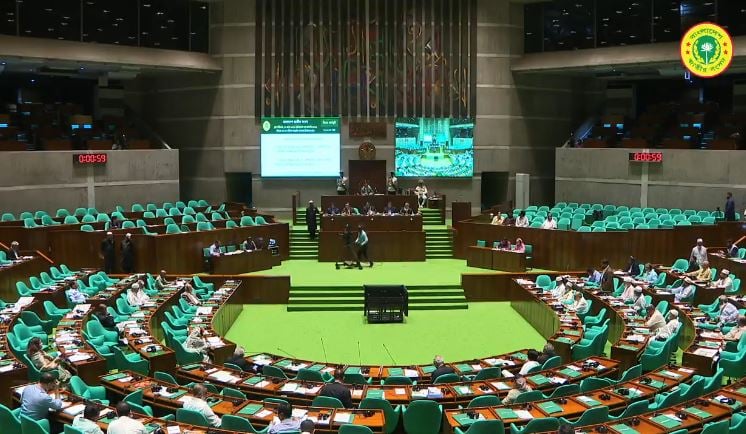
SANGSAD BHABAN, Aug 27, 2026 (BSS) - Three bills seeking to strengthen human rights protections, criminalise enforced disappearance and introduce lifetime usufruct rights in property transfers were placed in the Jatiya Sangsad today.
Law minister Md Asaduzzaman placed the National Human Rights Commission Bill, 2026 and the Transfer of Property (Amendment) Bill, 2026, while home minister Salahuddin Ahmed tabled the Prevention and Remedy of Enforced Disappearance Bill, 2026 and proposed to send the bills to the respective parliamentary standing committees for scrutiny.
Deputy speaker Barrister Kayser Kamal sent the bills to the respective parliamentary standing committees and asked to submit reports within two working days.
The National Human Rights Commission Bill sought to repeal the National Human Rights Commission Act, 2009 and replace it with a new legal framework aimed at creating an effective and independent commission.
In his statement of objectives and reasons, the law minister said respect for human rights was a fundamental commitment of the state and that Bangladesh remained committed to international human rights instruments, including the Universal Declaration of Human Rights.
The proposed commission would consist of a chairperson and four commissioners, with at least one woman member.
It also proposed giving preference to qualified candidates from national minority and disadvantaged communities on the recommendation of a selection committee comprising a university professor, a civil society representative and representatives of those communities.
The bill sought to clarify the commission's jurisdiction and make the complaint process easier. It would also empower the commission to issue interim orders to protect victims from immediate threats and prevent further harm while investigations are continuing.
A key provision is the proposed establishment of a National Preventive Mechanism (NPM) unit, in line with the Optional Protocol to the UN Convention against Torture. The unit would work to prevent torture, custodial deaths and enforced disappearances.
The move comes after the 13th Jatiya Sangsad, during its first session, passed the National Human Rights Commission (Repeal and Reintroduction) Bill, restoring the 2009 commission law and repealing three ordinances concerning the commission issued by the interim government.
Asaduzzaman said the government intended to develop a transparent and inclusive framework after consultations with political parties, marginalised communities and other stakeholders.
The Prevention and Remedy of Enforced Disappearance Bill, 2026 proposed life imprisonment for the offence of enforced disappearance. If a victim dies or remains untraced for more than five years, the punishment could be death or life imprisonment, along with a fine of up to Taka 1 crore.
The bill defined enforced disappearance as a cognisable, non-bailable and non-compoundable criminal offence, establishing a legal framework for prevention, prosecution, locating missing persons and protecting victims and their families.
In his statement of objectives and reasons, the home minister said the proposed legislation was intended to uphold human rights, human dignity, personal liberty and the rule of law.
Courts would be empowered to issue search warrants to trace disappeared persons. The bill also provided for trials in absentia, the admission of digital evidence and protection for witnesses, complainants, whistleblowers and victims.
Victims and their families would have the right to receive updates on investigations, seek the truth about what happened and learn the whereabouts or fate of the disappeared person.
The proposed framework also provided state-funded legal assistance, medical treatment, rehabilitation and compensation through a dedicated fund.
Compensation could be recovered from the assets of convicted persons, while the state would meet the cost where recovery was not possible.
Spouses and dependent family members would also be allowed to use the disappeared person's property for maintenance and essential expenses.
After five years, a certificate of disappearance could be issued to facilitate inheritance matters. The bill further proposed a central database and international cooperation in cases of enforced disappearance.
Both investigations and trials would be required to conclude within a maximum of 120 days.
However, the proposed legislation does not establish an independent investigative body. Responsibility for investigating enforced disappearance cases would remain with the police.
The Transfer of Property (Amendment) Bill, 2026 proposes changes to the Transfer of Property Act, 1882 to introduce legal recognition of lifetime usufruct rights.
The provision would allow parents, grandparents and other eligible donors to transfer property to specified blood relatives or spouses while retaining the legal right to use and enjoy the property during their lifetime.
According to the law minister's statement of objectives and reasons, the existing law sets out various forms of property transfer but contains no specific provision allowing a donor to make a gift while retaining lifetime enjoyment of the property.
The proposed amendment would add new Sections 122A and 122B to create lifetime usufruct-preserving gifts as a distinct form of property transfer. The provision would apply equally to people of all faiths.
The government said the new arrangement would not affect ordinary gifts, heba under Muslim law or other legally recognised forms of property transfer, nor would it create conflicts with those existing mechanisms.
The tabling of the bills also comes against the backdrop of the expiry of a number of ordinances promulgated by the interim government.
Twenty such ordinances, including measures, human rights, referendum and enforced disappearance lost their legal validity after failing to secure parliamentary approval within the constitutionally prescribed period.